
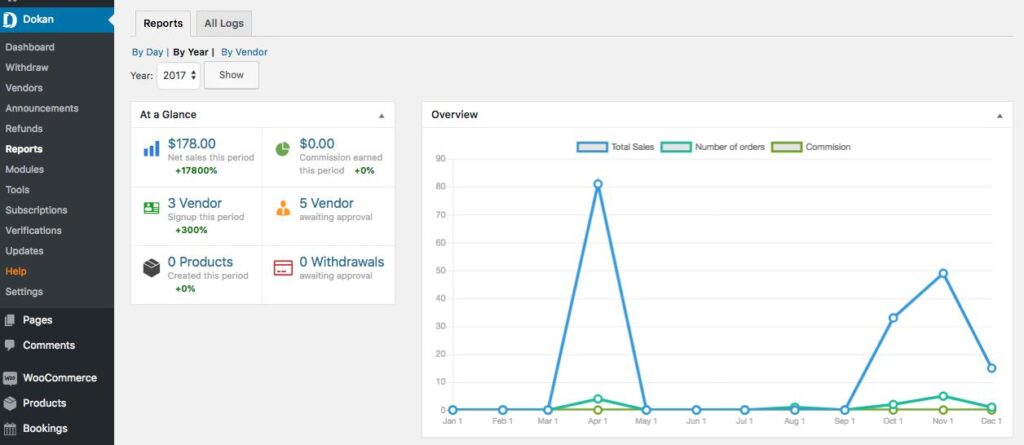
Dokan: Marketplace Vendor Commission Rules (Complete Guide 2026)
Running a multi-vendor marketplace requires a clear and reliable commission structure. Vendors need to understand how much they earn, while marketplace owners need a predictable way to calculate platform revenue.
Dokan Marketplace Vendor Commission Rules allow marketplace administrators to define how commissions are calculated across vendors, products, and sales.
A well-designed commission system can support different vendor agreements, product categories, promotional campaigns, and marketplace business models without creating unnecessary accounting complexity.
What Are Vendor Commission Rules?
A vendor commission rule determines how revenue from a vendor’s sale is divided between the marketplace and the seller.
For example:
Customer pays $100
- Vendor share: $90
- Marketplace commission: $10
The exact calculation depends on the marketplace’s commission configuration.
Commission structures can be simple or highly customized depending on business requirements.
Why Commission Rules Matter
A clear commission system helps:
- Standardize Vendor Earnings
- Predict Marketplace Revenue
- Reduce Payment Disputes
- Support Different Vendor Agreements
- Automate Commission Calculations
- Simplify Financial Reporting
- Improve Vendor Transparency
Commission rules should be documented clearly so vendors understand how their earnings are calculated.
Common Commission Models
1. Percentage-Based Commission
The marketplace takes a percentage of the sale.
Example:
10% Marketplace Commission
For a $200 sale:
- Vendor: $180
- Marketplace: $20
This is one of the simplest models for a marketplace.
2. Fixed Commission
The marketplace charges a fixed amount per transaction.
Example:
$5 commission per order
For a $100 sale:
- Vendor: $95
- Marketplace: $5
Fixed commissions can work well for certain low-complexity marketplaces.
3. Percentage + Fixed Commission
A marketplace can combine both models.
Example:
10% + $2 per order
For a $100 sale:
- Percentage commission: $10
- Fixed commission: $2
- Total commission: $12
- Vendor share: $88
This can provide a predictable minimum platform revenue per transaction.
Vendor-Specific Commission Rules
Not every vendor needs to have the same commission rate.
For example:
| Vendor Type | Commission |
|---|---|
| Standard Vendor | 15% |
| Premium Vendor | 10% |
| Enterprise Vendor | 7% |
| New Vendor Promotion | 5% |
Vendor-specific rules can support negotiated commercial agreements.
Category-Based Commission
Commission rates can also vary by product category.
For example:
| Category | Commission |
|---|---|
| Electronics | 8% |
| Fashion | 12% |
| Home & Garden | 15% |
| Accessories | 18% |
This can be useful when product margins vary significantly across categories.
Product-Based Commission
A marketplace may need individual commission rules for specific products.
For example:
- Product A → 5%
- Product B → 10%
- Product C → 15%
This provides more granular control than a marketplace-wide commission rate.
Tiered Commission Rules
Commission rates can change according to vendor sales volume.
Example:
| Monthly Sales | Commission |
|---|---|
| $0–$5,000 | 15% |
| $5,001–$15,000 | 12% |
| $15,001+ | 10% |
This can encourage vendors to increase sales while rewarding high-performing sellers.
Vendor Membership-Based Commission
A marketplace can create different vendor plans.
Basic
15% commission
Professional
10% commission
Enterprise
7% commission
Membership-based commission structures can create an additional marketplace revenue model.
Promotional Commission Rules
Temporary commission rates can be useful for:
- New Vendor Promotions
- Product Launches
- Seasonal Campaigns
- Category Promotions
- Vendor Acquisition
For example:
Standard commission: 15%
New vendor promotion: 8% for the first 90 days
Promotional rules should have clearly defined start and end dates.
Commission on Discounts
One important consideration is how commissions interact with discounts.
Suppose:
- Product price: $100
- Coupon discount: $20
- Final customer price: $80
- Commission: 10%
The marketplace needs a clearly defined rule determining whether commission is calculated from:
$100 or $80
This should be documented because it directly affects vendor earnings.
Commission and Taxes
Tax handling can become complicated in multi-vendor marketplaces.
The marketplace should clearly define how commission calculations interact with:
- Product Tax
- Shipping Tax
- Discounts
- Fees
- Refunds
Tax rules vary by jurisdiction, so businesses should obtain appropriate professional tax advice for their specific structure.
Commission on Shipping
Another important question is whether shipping charges are included when calculating commission.
For example:
Product: $100
Shipping: $10
Commission: 10%
Possible approaches include:
Product Only
Commission = $10
Product + Shipping
Commission = $11
The marketplace should choose and document one consistent approach.
Commission on Coupons
Coupon handling should also be defined.
Consider:
Product: $200
Coupon: $40
Customer pays: $160
The marketplace needs to establish whether the vendor commission is based on:
- Original Product Price
- Discounted Product Price
- Another defined calculation
Clear rules prevent vendor disputes.
Refunds and Commission Reversals
Refunds require careful commission handling.
Suppose:
Order: $100
Commission: $10
Vendor: $90
If the customer receives a full refund, the marketplace should determine how the original commission is reversed.
A robust system should maintain a clear transaction history showing:
- Original Sale
- Commission
- Refund
- Commission Reversal
- Final Vendor Balance
Partial Refunds
Partial refunds introduce additional complexity.
For example:
Order: $200
Refund: $50
The system needs to calculate the appropriate vendor and marketplace adjustments.
This should be automated wherever possible to reduce accounting errors.
Multiple Vendors in One Order
A customer may purchase products from several vendors in one checkout.
For example:
Vendor A: $100
Vendor B: $150
Each vendor may have a different commission rate.
The marketplace must calculate each vendor’s earnings separately.
A simplified example:
| Vendor | Sales | Commission | Vendor Earnings |
|---|---|---|---|
| Vendor A | $100 | 10% | $90 |
| Vendor B | $150 | 15% | $127.50 |
The marketplace receives $32.50 in commission.
Commission Rules Priority
When multiple rules exist, the marketplace needs a clearly defined priority system.
For example:
Marketplace Default
↓
Vendor Rule
↓
Category Rule
↓
Product Rule
The actual priority should be documented and implemented consistently.
Without a clear hierarchy, administrators may struggle to understand why a particular commission was applied.
Vendor Commission Dashboard
Vendors should be able to understand their earnings.
Useful information includes:
- Gross Sales
- Commission
- Refunds
- Fees
- Net Earnings
- Withdrawals
- Available Balance
- Pending Balance
Transparent reporting can significantly reduce support requests.
Admin Commission Dashboard
Marketplace administrators may need:
- Total Sales
- Total Commission
- Vendor Earnings
- Commission by Vendor
- Commission by Category
- Commission by Product
- Refund Adjustments
- Withdrawal Data
Reports can help management understand marketplace profitability.
Commission Reports
Useful reports include:
Vendor Commission Report
Shows commission and earnings for each vendor.
Product Commission Report
Shows commission generated by individual products.
Category Commission Report
Shows marketplace revenue by category.
Date-Based Commission Report
Shows commission within a specific period.
Refund Commission Report
Shows commission adjustments resulting from refunds.
Commission Export
For accounting and financial reconciliation, administrators may need to export commission information.
Useful formats include:
- CSV
- XLSX
Exports can contain:
- Order ID
- Vendor
- Product
- Gross Amount
- Discount
- Commission
- Refund
- Vendor Earnings
- Date
- Payment Status
Vendor Withdrawal Rules
Commission management is closely connected to vendor withdrawals.
Possible rules include:
- Minimum Withdrawal Amount
- Withdrawal Schedule
- Manual Approval
- Automatic Payouts
- Payment Method
- Withdrawal Fees
- Holding Period
A marketplace may hold vendor earnings temporarily to account for refunds, disputes, or order fulfillment.
Commission and Payment Timing
The marketplace should define when vendor earnings become available.
Possible models include:
Immediate
Vendor earnings become available immediately after payment.
After Fulfillment
Earnings become available after the order is fulfilled.
After Delivery
Earnings become available after delivery.
After a Holding Period
Earnings become available after a predefined number of days.
The appropriate model depends on the marketplace’s risk and operational requirements.
Commission Transparency
Vendors should be able to clearly understand:
Sale → Fees → Commission → Refund → Final Earnings
Avoid hidden calculations.
A transparent commission system improves vendor trust and reduces disputes.
Custom Commission Development
Some marketplaces require rules that go beyond standard configuration.
Custom development may be needed for:
- Vendor-Specific Rules
- Product-Level Rules
- Category-Level Rules
- Tiered Commissions
- Promotional Rates
- Minimum Fees
- Maximum Fees
- Conditional Rules
- Subscription-Based Commissions
- Custom Financial Reports
Custom logic should be documented and tested thoroughly.
Commission Automation
Commission calculations should ideally happen automatically when orders are created or updated.
Automation can handle:
- Commission Calculation
- Vendor Earnings
- Refund Adjustments
- Commission Reversals
- Withdrawal Balances
- Financial Reports
Automation reduces manual accounting work and the possibility of calculation errors.
Testing Commission Rules
Before launching a commission system, test multiple scenarios.
Test 1: Standard Sale
Verify the normal commission calculation.
Test 2: Vendor-Specific Commission
Verify that the vendor’s custom rate overrides the appropriate default.
Test 3: Discounted Product
Check how coupons affect commission.
Test 4: Shipping
Verify whether shipping is included.
Test 5: Refund
Verify commission reversal.
Test 6: Partial Refund
Verify proportional adjustments.
Test 7: Multi-Vendor Order
Verify separate vendor calculations.
Test 8: Withdrawal
Verify available vendor balance.
Common Commission Mistakes
No Clear Rule Priority
Administrators may not know which commission rule is being applied.
Ignoring Refunds
Refunds can create incorrect vendor balances if commission reversals aren’t handled properly.
Hidden Calculations
Vendors may lose trust if they cannot understand their earnings.
Manual Calculations
Manual commission calculations increase accounting errors.
No Testing
Complex commission rules should be tested against realistic order scenarios.
Dokan Marketplace Vendor Commission Checklist
Commission Configuration
- Default Commission
- Vendor-Specific Commission
- Product Commission
- Category Commission
- Fixed Commission
- Percentage Commission
- Tiered Commission
Order Calculations
- Discounts
- Coupons
- Shipping
- Taxes
- Fees
- Refunds
- Partial Refunds
- Multi-Vendor Orders
Vendor Earnings
- Gross Sales
- Commission
- Refunds
- Net Earnings
- Pending Balance
- Available Balance
- Withdrawals
Reporting
- Vendor Reports
- Product Reports
- Category Reports
- Date Reports
- Refund Reports
- Commission Exports
Testing
- Standard Orders
- Discounted Orders
- Multi-Vendor Orders
- Refunds
- Partial Refunds
- Withdrawals
- Edge Cases
Best Practices
- Define the default commission clearly.
- Document commission rule priority.
- Keep vendor-specific agreements organized.
- Make commission calculations transparent.
- Automate commission and refund calculations.
- Test discounts, shipping, taxes, and refunds.
- Provide vendors with detailed earnings reports.
- Reconcile commissions against actual payments.
- Review commission rules regularly.
- Use custom development only when standard configuration cannot meet the business requirement.
Final Thoughts
Dokan Marketplace Vendor Commission Rules form the financial foundation of a multi-vendor marketplace. A well-designed system ensures that vendors receive accurate earnings while the marketplace collects the correct revenue.
The most important part is not simply choosing a commission percentage. Marketplace owners need to define how commissions interact with vendors, products, categories, discounts, shipping, taxes, refunds, multi-vendor orders, and withdrawals.
A transparent and automated commission system reduces accounting errors, minimizes vendor disputes, and gives marketplace administrators better control over profitability.
As the marketplace grows, commission rules should be documented, tested, monitored, and periodically reviewed to ensure they continue to match the business model.

Hire Me on Upwork – Dokan & WooCommerce Expert

 Chat on WhatsApp